Paver Driveways Scranton
Why Driveway Pavers Require Different Planning
A driveway and a patio may use the same paver brand, but they are not the same project. A driveway carries thousands of pounds of concentrated vehicle load, repeatedly, in a climate that freezes and thaws. That load transfers through the paver into the base, so the base has to be deeper, more densely compacted, and better restrained at the edges than a pedestrian surface.
The paver installation discipline is the same — excavation, compacted aggregate, bedding, edge restraint, joint material — but the section is heavier. Base depth follows the expected load and the subsoil. A driveway on heavy clay or poorly draining ground needs more base than one on well-drained sandy subsoil. There is no single number that fits every driveway.
Edge restraint matters more under vehicle load because vehicles turn, brake, and place lateral force on the field. Without heavy restraint, the perimeter units migrate first, joints open, and the surface loses alignment. The same concrete pavers used for a patio may not be rated for a driveway — the paver itself has to match the load.
Load Changes Everything
Deeper base · heavier compaction · heavier edge restraint · vehicle-rated paver · drainage at the garage transition.
Driveway Paver Patterns, Borders & Entry Design
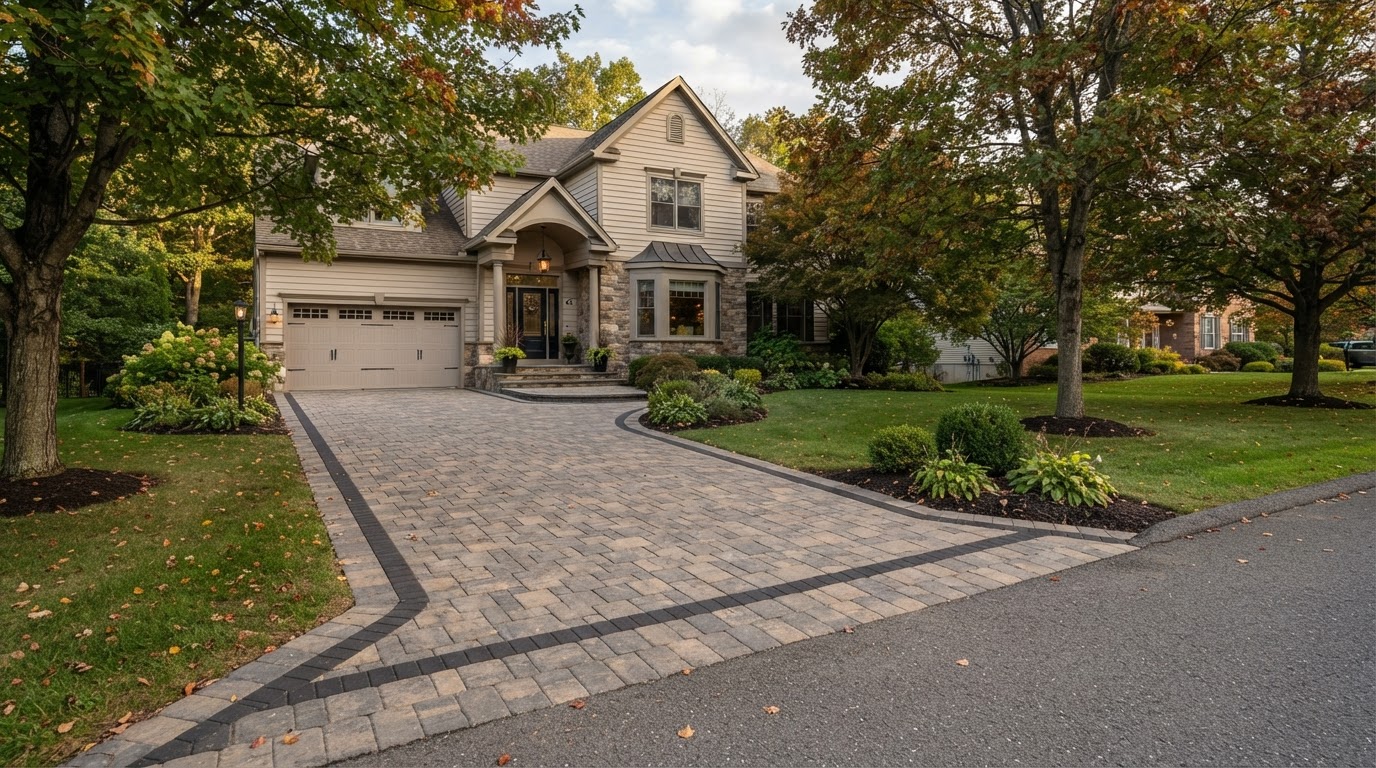
Driveway design can use pattern and border to elevate a functional surface without becoming ornate. Herringbone resists lateral movement well and is a strong choice for driveways; a contrasting border frames the field; an entry accent at the apron signals the transition from street to property.
Herringbone Field
Interlocking pattern that resists lateral shift under turning and braking loads.
Contrasting Border
A soldier or sailor course in a contrasting tone frames the field and defines edges.
Entry Apron Accent
An accent band at the street apron marks the transition onto the property.
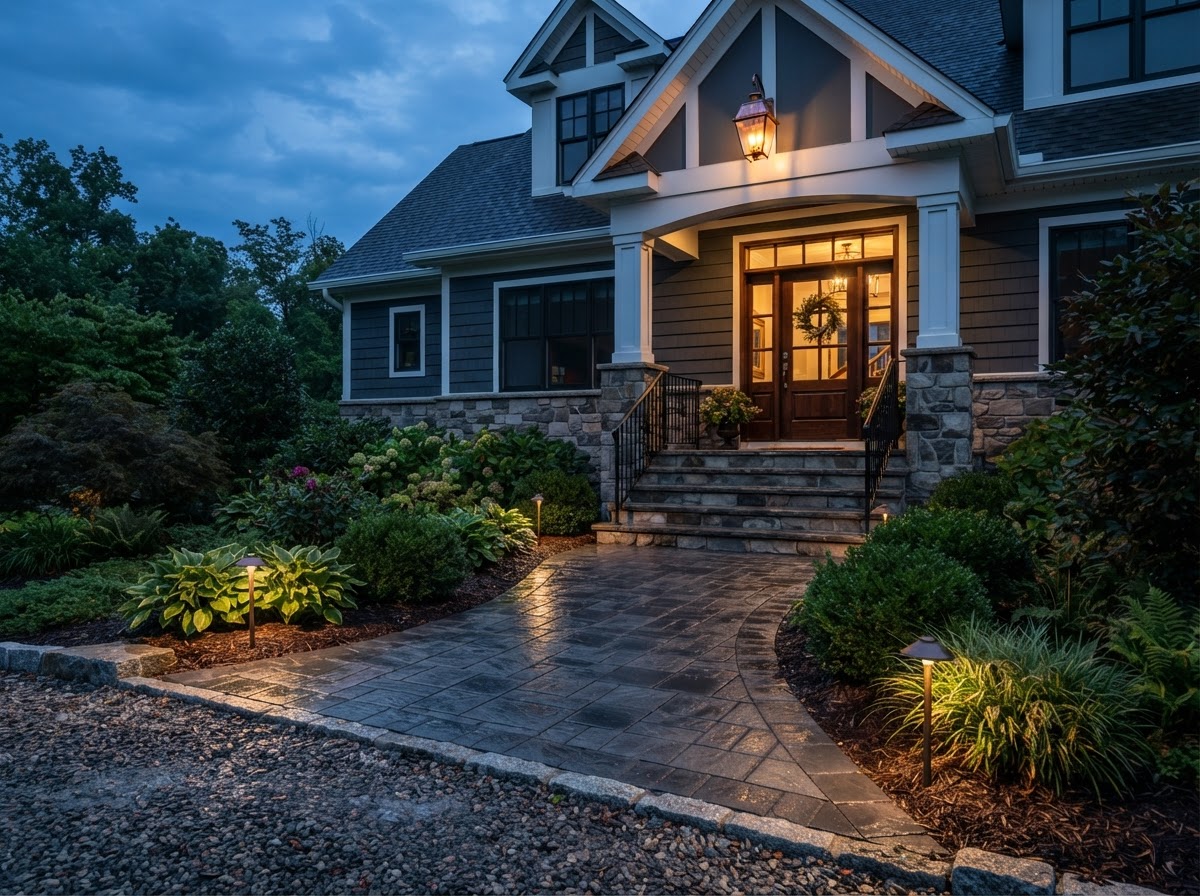
Matching Walkway
The same or complementary paver on the walkway ties the front hardscape together.
For the coordinated front treatment — driveway, walkway, steps, and entry — see front yard hardscape & entryway renovation.
Base Preparation, Drainage & Vehicle Loads
Base and compaction. A driveway base is excavated deeper than a patio base and compacted in lifts to a higher density, because it has to distribute concentrated vehicle load without settling. On poorly draining subsoils, geotextile separation keeps the base from migrating down. Underbuild the base and the surface will reflect every settlement and frost heave.
Drainage. The driveway surface sheds water, and the surrounding grade has to carry it somewhere safe — not toward the foundation or the garage. At the garage transition, drainage is planned so water does not back up against the slab. On sloped lots, drainage solutions and yard grading often run alongside the driveway build.
Snow, freeze-thaw, and stains. Snow removal places abrasion and salt on the surface; freeze-thaw works on the base and joints. A vehicle-rated paver with full polymeric joints resists both, and sealing adds stain resistance against oil and fluids. Pavers are not maintenance-free — joints eventually need re-sanding and the surface benefits from sealing on a cycle.
Individual unit replacement. When a unit does crack or settle, it can be lifted and replaced individually, or a settled section lifted and re-leveled — the core advantage over a poured slab. See sunken paver repair & leveling.
Paver Driveways for Northeastern Pennsylvania Homes
A paver driveway on a Northeastern Pennsylvania property has to handle snow removal, repeated freeze-thaw, vehicle load, and the grade of the lot — often all at once. The defense is in the base and drainage, not just the surface. Done well, an interlocking driveway stays level through winter and can be repaired unit by unit rather than cracking and requiring full replacement like a poured slab.
Snow & Salt Exposure
Vehicle-rated pavers with full polymeric joints resist abrasion and salt; sealing adds protection on a maintenance cycle.
Freeze-Thaw in the Base
Compaction and drainage in the base prevent water from freezing and heaving the surface through a NEPA winter.
Sloped Driveways
Grade and drainage matter more on a slope — surface pitch, edge drainage, and the garage transition all have to work together.
Repairability Over Replacement
Settled or stained units lift and replace individually, avoiding the cost and disruption of a full slab replacement.
Planning a Paver Driveway?
Discuss vehicle load, base conditions, drainage, and the entry look you want.
Paver Driveway Questions
Connected Driveway & Front Hardscape
Paver Installation
The installation discipline behind every paver surface.
Walkways & Pathways
Connecting the driveway to the entry with matching pavers.
Front Yard & Entryways
Coordinated driveway, walkway, and entry hardscape.
Paver Sealing
Stain and salt protection for driveway pavers.